December 2, 2025.
Author: Sandro Baricevic
This year Casale Monferrato hosted a historic convergence of tradition and renewal, bringing together nobility, chivalry, scholars, and institutions to strengthen chivalry for the 21st century!
On Saturday, 8 November 2025, a unique convergence of noble tradition and new horizons for the chivalric world took place. The historic town of Casale Monferrato hosted the landmark event celebrating Europe’s chivalric and noble heritage, while charting its future: Lo Storico Galà della Nobiltà 2025. This historic day also included the General Assembly of the International Commission for Orders of Chivalry (ICOC), drawing aristocrats, scholars, and dignitaries from across the globe.
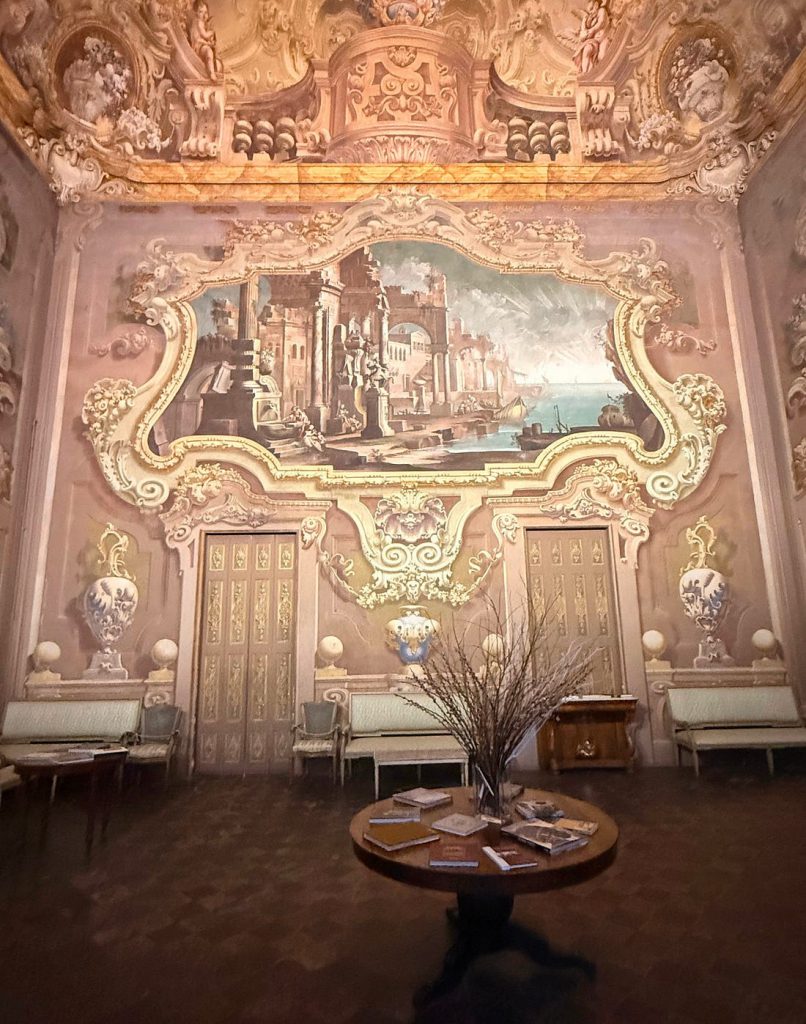
Palazzo Gozzani di Treville, an 18th-century architectural jewel in the heart of Casale Monferrato
Hosted under the patronage of Famiglie Storiche d’Italia, with support from Historical Families of Europe and the Circolo dei Cento e non più Cento, the Nobility Gala marked its fourth edition with elegance and scholarly focus, under the careful eyes of Nob.Dott. Pier Felice degli Uberti and Nob. Dott. Loredana Pinotti degli Uberti.
This year’s gala paid tribute to H.S.H. Prince Marchese Don Maurizio Gonzaga del Vodice di Vescovato, revered as the Head of the Most Serene House of Gonzaga. This dynasty once ruled Mantua and boasts a history spanning seven centuries.
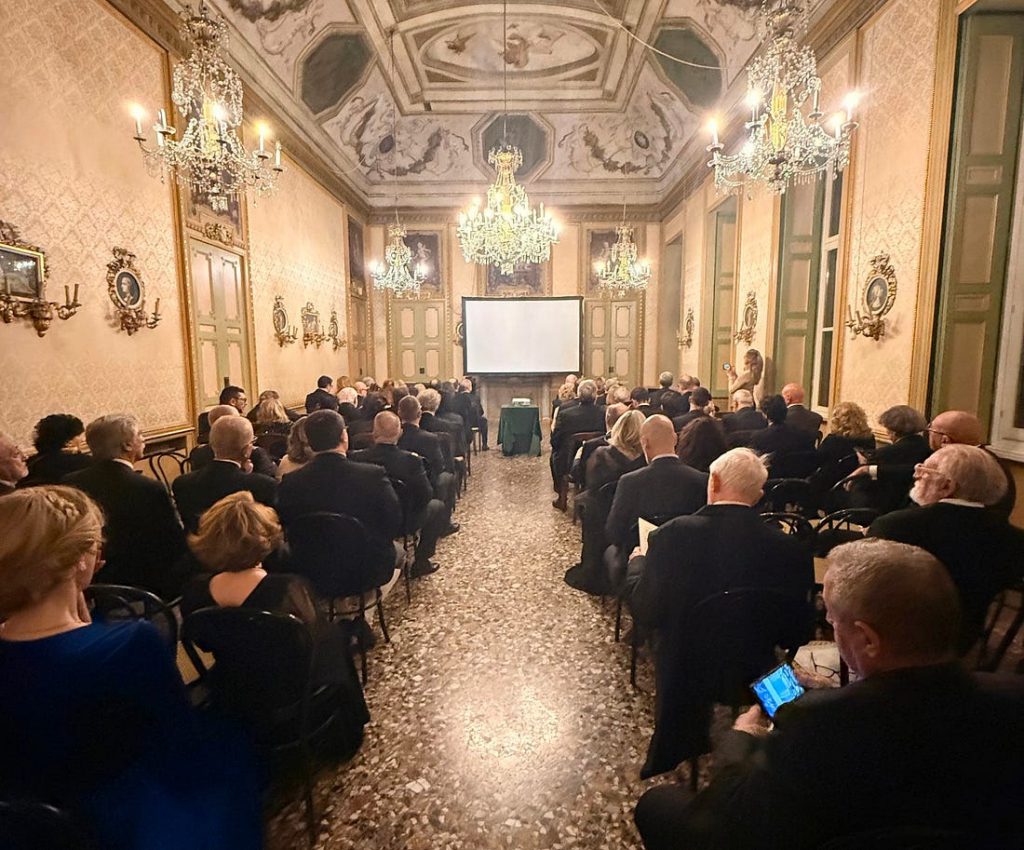
Opening of the Lo Storico Galà della Nobiltà 2025
Among the distinguished guests were H.I.&R.H. Archduke Josef Karl of Habsburg-Lorraine and Prince Guglielmo Giovanelli Marconi, alongside representatives of noble associations from various parts of Europe.
Attendees ranged from delegates of the Convention of the Baronage of Scotland to members of Hungary’s venerable Vitézi Rend, and even the Herald of the Royal Orders of the Swedish Royal House. The gathering amounted to a true pan-European aristocratic salon, set against the baroque backdrop of Casale’s Palazzo Gozzani di Treville, an 18th-century architectural jewel in the heart of Casale Monferrato, provided an appropriately grand setting for the evening.
Home to the city’s Accademia Filarmonica since 1827, the Palazzo’s frescoed halls and crystal chandeliers lent an atmosphere of old-world elegance to the occasion. As guests in formal evening attire arrived, they mingled under gilded ceilings where, centuries ago, the Marchesi of Monferrato patronized the arts.
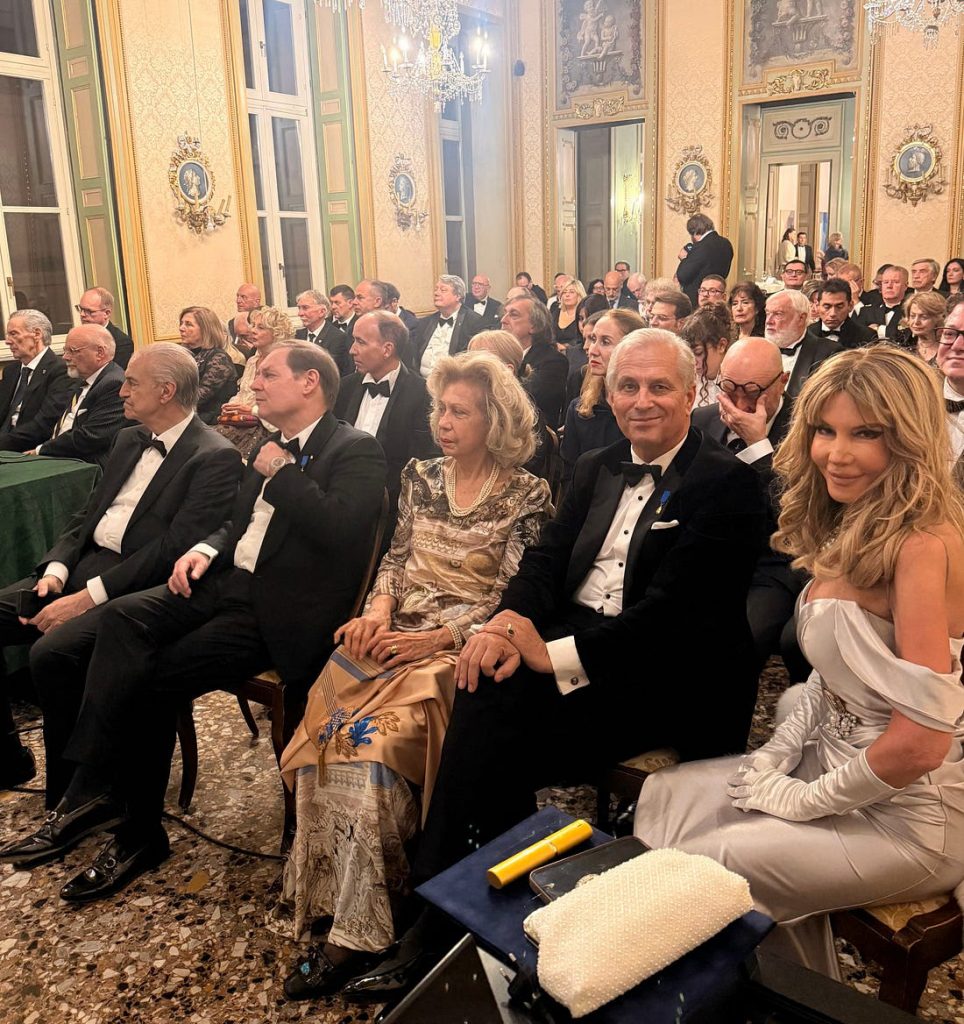
Distinguished guests of Lo Storico Galà della Nobiltà 2025
Studium Accademia di Casale e del Monferrato
The day’s program began at 17:30 with a cultural conference, the Studium, founded in 1476 by Prince Guglielmo I Paleologo. Attendees were treated to a carefully curated series of insightful talks bridging history, culture, and noble traditions.
H.S.H. Prince Maurizio Gonzaga del Vodice di Vescovato initiated the proceedings with a deep dive into “The Nobility of the Gonzaga in Seven Centuries of History,” reflecting on the enduring legacy of the Serene House of Gonzaga from medieval times to the present. His presentation illuminated how the Gonzagas, once dukes of Mantua and noted patrons of the arts, have navigated the tides of history, underscoring the relevance of noble heritage in today’s world.
The focus then shifted to a joint presentation of Vitéz Nob. Dr. Come. Ádám Berniczei-Roÿkó de Bernicze et Csetnek and Nob.Dott. Pier Felice degli Uberti, who together examined “The Nobility of the Vitézi Rend and Its Institutional Diversity in Chivalric History.” The legendary Vitézi Rend, or the Order of Vitéz, originally founded in 1920 to honor Hungarian war heroes, was presented as a case study in how chivalric institutions evolve and adapt legally over time.
Nob.Dott. Pier Felice degli Uberti shared that he cited the Vitézi Rend as an example of a forward-looking chivalric institution for the 21st century, at the 10th Anniversary of the World Changers Summit 2025, held on 22 October 2025 at the Pontifical Academy of Sciences in Vatican City.
Vitéz Nob. Dr. Come. Ádám Berniczei-Roÿkó de Bernicze et Csetnek traced the Order’s journey through the 20th century, highlighting its unique nature as both an order of merit and a hereditary institution. Their talk underscored the broader theme of the conference: the institutional diversity within chivalric and nobiliary traditions, and how these bodies remain relevant by adjusting to new social and legal realities.
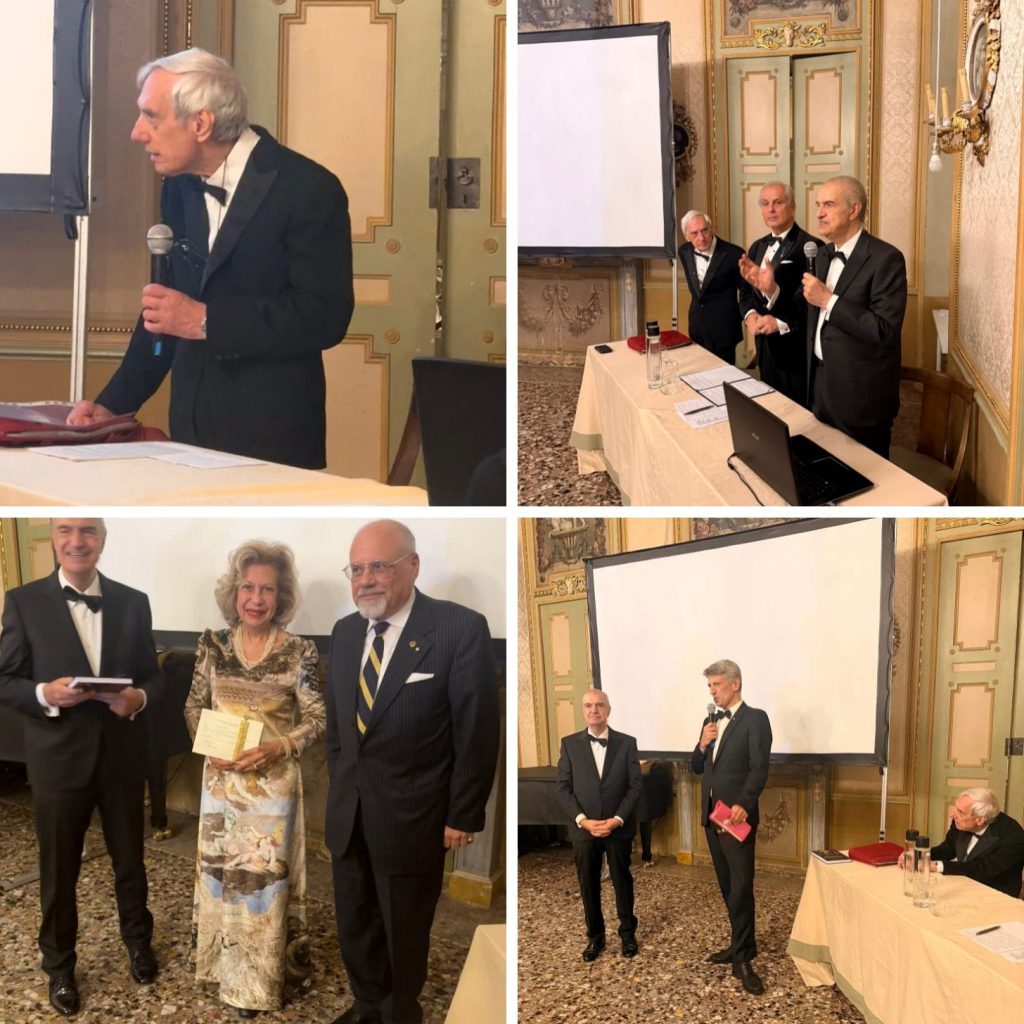
The Lectures of the Studium Accademia di Casale e del Monferrato
The Studium continued with a sweeping Middle European perspective from Dr. Guido Broich, whose lecture “The Confraternity of Sant’Ambrogio: A Bridge Between the Lay and Religious Worlds Dedicated to Defending Central European Culture” explored the historic fellowship’s role in safeguarding cultural heritage. This was a vivid reminder that noble traditions often intersect with religious and civic life, in this case, highlighting how a Milanese confraternity became a bulwark for Central European cultural identity amid turbulent times.
A dramatic moment came with the final presentation of Nob.Dott. Pier Felice degli Uberti and filmmaker Luciano Francesco Silighini Garagnani Lambertini, turning the spotlight on the proliferation of fraudulent titles and fabricated genealogies.
Silighini Garagnani Lambertini shared an introductory excerpt of his latest investigative documentary, tellingly titled “Genealogical and Documentary Forgeries to Create Business…”, an exposé of the shadowy market for fake family trees, invented noble titles, and even sham “micronations”. He also recounted in detail how this conspiracy of forgers has targeted true experts, including Nob.Dott. Pier Felice degli Uberti himself, in a bid to discredit them and lend false legitimacy to their schemes.
While careful not to name names publicly, Silighini Garagnani Lambertini affirmed he has identified those behind the attacks and turned over evidence to authorities. The audience learned that a full premiere of this explosive film is upcoming, promising a reckoning for what he terms “fake principalities” and illegitimate orders and titles that prey on the allure of nobility.
New Academics of the Studium and Supporters of Historical Families of Italy
As the conference segment ended, the organizers took time to honor contributors to the cause of cultural heritage.
In a brief ceremony, a class of new Supporters of Historical Families of Italy was admitted, a recognition bestowed on those who embrace the association’s mission of preserving genealogical and heraldic knowledge. This honor, which is free and granted upon request, signifies one’s adherence to the principles of Historical Families of Italy and comes with a certificate presented at the gala.
Those received were: Prof. Dr. Amalia Patrone Barberis, Avv. Max Francioli, Mrs. Isolina Rossi, Avv. Cesare Vernarecci di Fossombrone, Dr. Massim Carati Saronni, Dr. Sandro Spinucci, Dr. Domenico Gianarro, Dr. Francesco Garofalo, and Prof. Dr. Raffaella Saponaro Monti Bragadin.
Notably, Mr. Jonas Arnell, Herald of the Orders of the Royal House of Sweden, was distinguished with the title of “Merit Supporter” for his outstanding commitment.
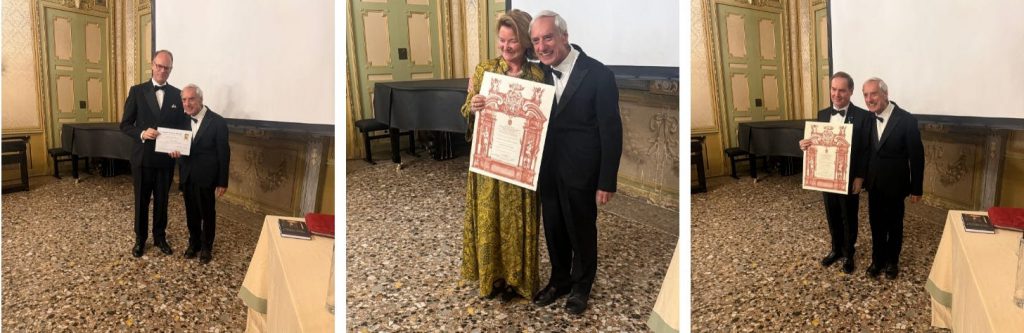
Nomination of Supportert of Historical Families of Italy, and admittance of new members of the Studium Accademia di Casale e del Monferrato
In addition, the Studium Accademia di Casale e del Monferrato welcomed new members into its ranks that afternoon: several scholars and nobles were co-opted as academicians in fields ranging from art and literature to history and the sciences.
Among those formally received were:
- Dr. Prof. Amalia Patrone Barberis, Associate Academic;
- Dr. Sandra Mazzoli, Academic;
- Dr. Prof. Prince Guglielmo Giovanelli Marconi, Academic Senator;
- Col. Com. ACISMOM Landolfo Ambrogio Caracciolo di Melissano, Academic Senator;
- Prof. Eng. Gionata Barbieri, Academic Senator.
These appointments underscored a central theme of the event: the continuity of noble and learned traditions through new generations of participants.
A Royal Announcement for “the Royal Protocol”
The Studium reached its peak with a virtual video address by H.R.H. Prince Emanuele Filiberto of Savoy, Duke of Savoy, Prince of Piedmont and Venice, grandson of King Umberto II, and Royal Patron of The Investiture.
In his message, he unveiled Royal Protocol, a project designed to bring genealogy, heraldry, noble law, and chivalric orders into the digital age through blockchain technology. The system aims to create an immutable, traceable ledger for pedigrees, titles, and honors, protecting them from falsification, an issue highlighted earlier in Silighini’s documentary.
H.R.H. Prince Emanuele Filiberto of Savoy placed the initiative in historical context: since the abolition of the monarchy in 1946, Italy has offered no official protection for noble titles or chivalric orders, leaving space for illegitimate actors. Royal Protocol seeks to fill this vacuum by restoring authoritative oversight, following the 1943 ordinance that once vested the King with exclusive authority over titles and arms. As heir to King Umberto II’s moral and incorporeal legacy, the Prince affirmed his duty to administer this heritage “with seriousness, responsibility, and rigor.”
He stressed that Royal Protocol will rely on qualified experts and apply the last lawful regulations of the Kingdom of Italy, adapted for modern use. It will recognize the Dynastic Orders of the House of Savoy, as well as orders acknowledged under the Italian Republic’s 1951 law. For other traditions, it will refer to international standards, notably the I.C.O.C. Register, ensuring transparency and global compatibility.
The Royal Protocol project’s scope is broad: it aims to reconstruct genealogies not only of noble families but also of Italians abroad who have regained citizenship and wish to reconnect with their origins. It also intends to restore the historical value of families that contributed to Italy’s cultural and civic development.
Royal Protocol includes a philanthropic mission as well. Part of its proceeds will support the restoration of ruined Italian monuments, from castles to churches, linking advanced technology with the safeguarding of physical heritage.
H.R.H. Prince Emanuele Filiberto of Savoy closed with a call to revive Italy’s memory, dignity, and beauty. Though still in its early phase, with the Royal Protocol website already active, the announcement sparked lively discussion among attendees, an appropriate reception in a gathering of Europe’s leading guardians of heraldry and genealogy.
Celebrating Artistry and Ancestry
After the Studium and the announcement of Royal Protocol, the evening moved to cultural celebrations. At 8:00 PM, the grand salon of the Accademia Filarmonica hosted the final stage of the VIII Heritage & Tradition of Europe Awards, founded in 2018 at Castello di Belgioioso and traditionally paired with the autumn Nobility Gala. The competition highlights emerging talent in classical music, opera, literature, painting, and haute couture across Europe.
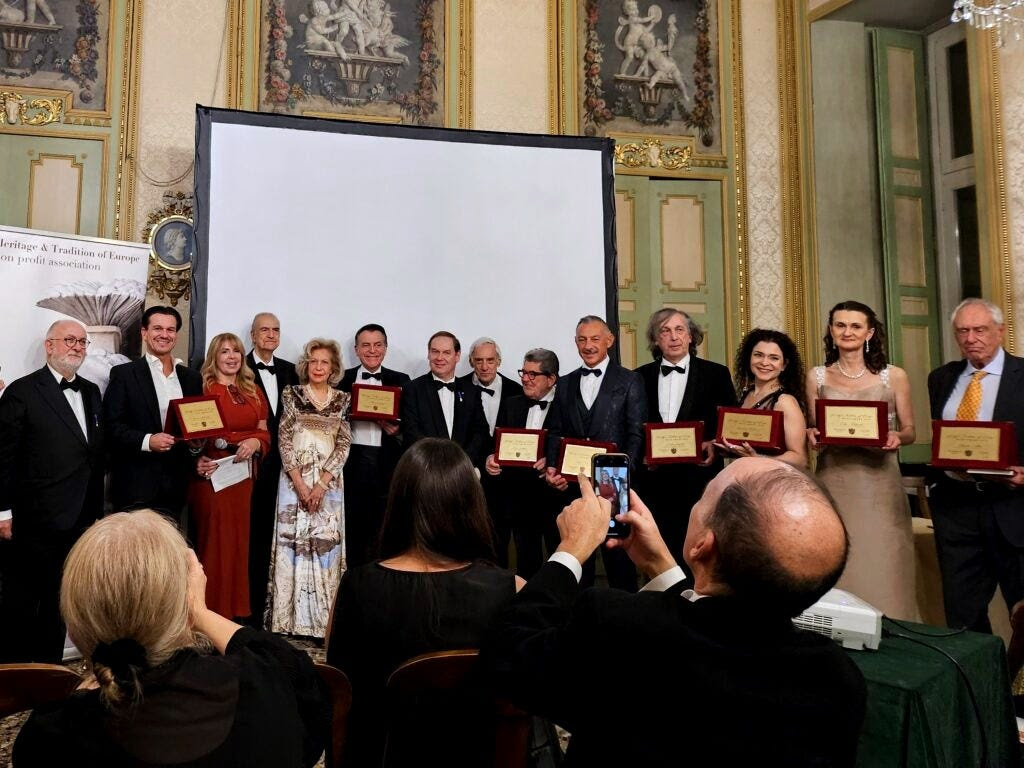
The Laureates of the VIII Heritage & Tradition of Europe Awards
The ceremony was coordinated by Katia Ferri Melzi d’Eril and Elena Kebrite. Live operatic arias and Baroque pieces filled the hall, while a curated exhibition of artworks and haute couture designs by the finalists lined the room.
After deliberations, the jury announced the 2025 laureates of the VIII Heritage & Tradition of Europe Awards:
- Poetry – Paolo Zampetti
- Classical Music – Olga Medyanik (baroque soprano)
- Opera – Giovanni Ribichesu (tenor)
- Narrative Literature – Francesca Daccò (publihsed novel) and Marco Gallotti (unpublished novel)
- Art – Stefano Bressani (painter and sculptor)
- Fashion – Antonio Patriarca (stylist)
Their announcements were met with warm applause, underscoring the ongoing role of noble patronage in supporting the arts.
Gala Dinner in a Historic Hall
The day concluded with the gala dinner, held in two ornate halls of the Accademia Filarmonica. Tables set with crystal and silver welcomed more than 160 guests, who enjoyed Monferrato’s signature cuisine and local wines.
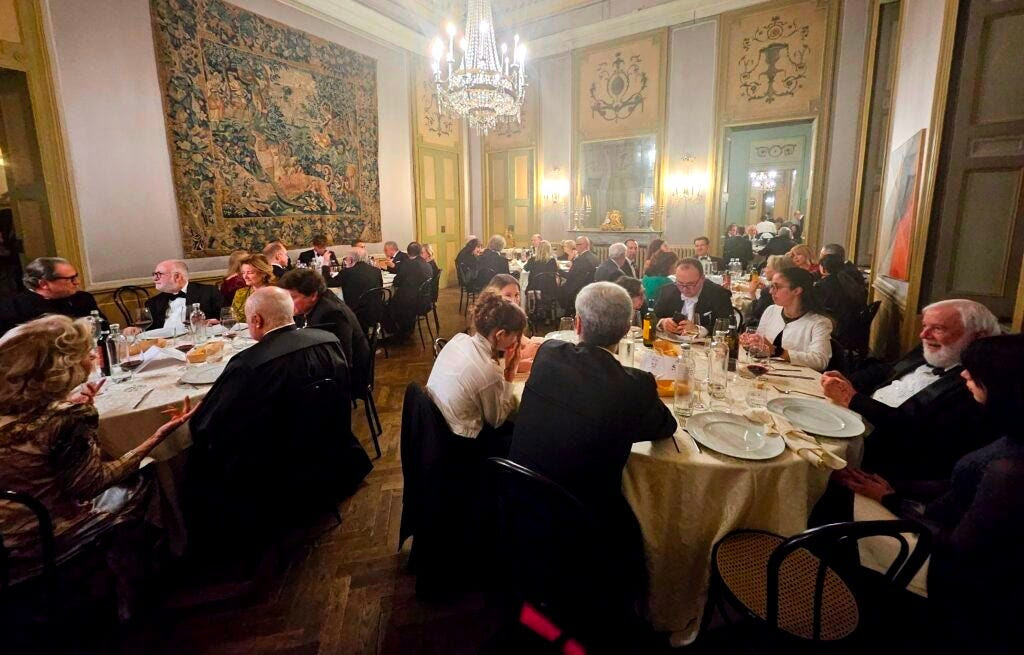
Seats mixed members of distinguished Italian families with international representatives of cultural and chivalric institutions. Conversation ranged from shared genealogical research to upcoming heritage projects, reflecting the network of collaborations that regularly emerges from this gathering.
Throughout the evening, the atmosphere remained celebratory. Guests toasted the day’s scholarly sessions, the newly honored artists, and the recently admitted Supporters and Academicians.
The participants shared spontaneous gratitude to Nob.Dott. Pier Felice degli Uberti, President of the I.C.O.C., and Nob.Dott. Loredana Maria Pinotti degli Uberti, for their leadership in orchestrating the day’s events. The dinner closed in an atmosphere of warm camaraderie, true to the spirit of the Nobility Gala.
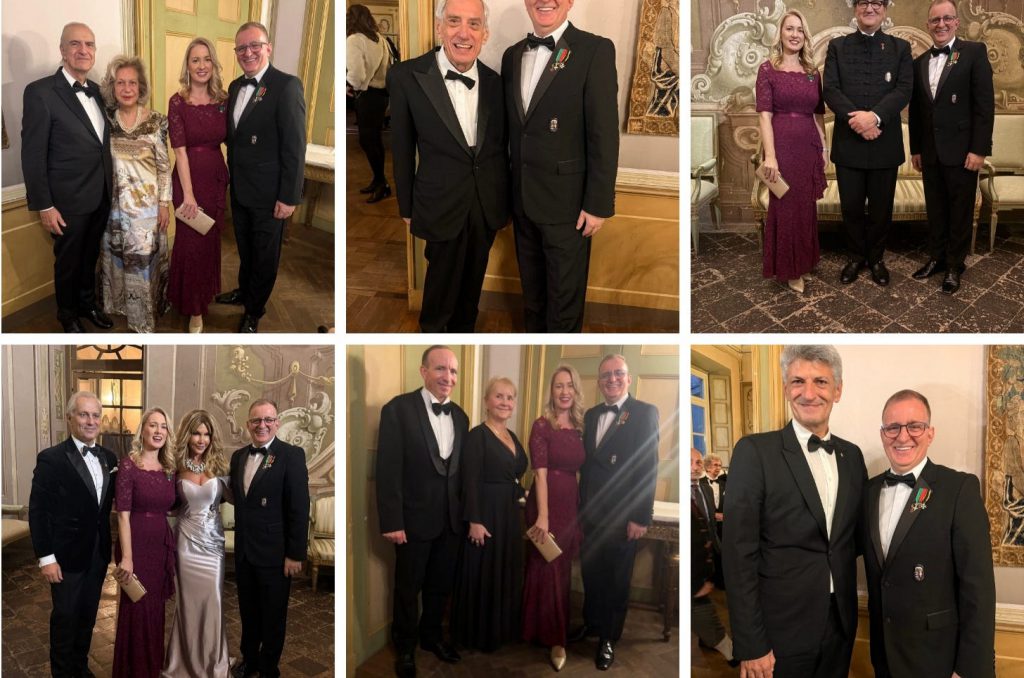
The Investiture’s Editor-in-Chief, Sandro Baričević, with the organizers and the distinguished guests of Lo Storico Galà della Nobiltà 2025
ICOC Assembly: Updating Chivalric Principles for the 21st Century
That afternoon in Casale Monferrato, the Annual General Assembly of the International Commission for Orders of Chivalry (ICOC) met in a hall of the Accademia Filarmonica. Founded in 1960, the ICOC is the leading private scholarly authority distinguishing legitimate orders of knighthood from self-styled or fraudulent ones. Its Register of Orders of Chivalry remains a widely recognized reference. The 2025 assembly focused on the need to update the Fundamental Principles adopted in 1962 in Edinburgh, now more than six decades old.
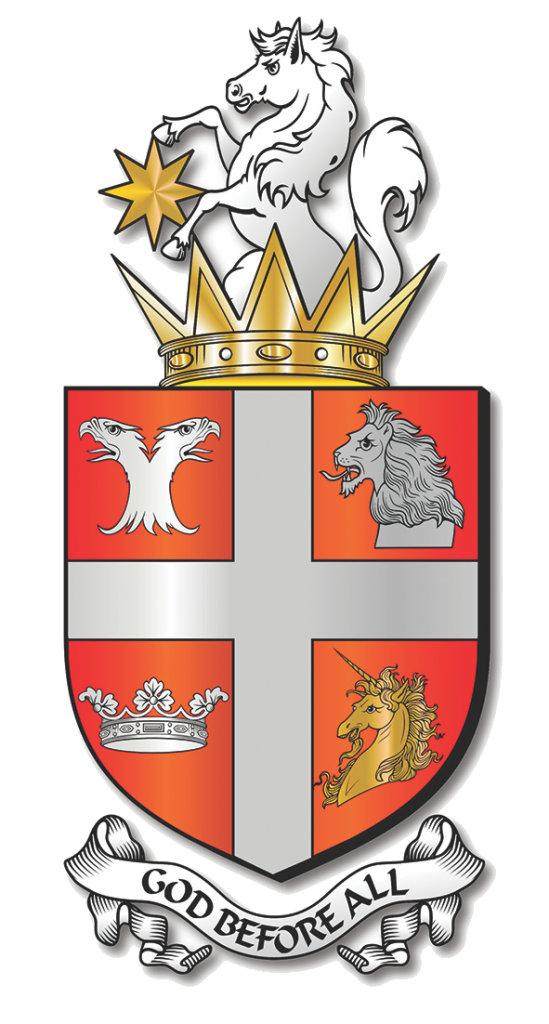
The Coat of Arms of the International Commission for Orders of Chivalry (I.C.O.C.)
Presided over by Nob.Dott. Pier Felice degli Uberti, ICOC President, the meeting noted how shifts in global politics, the fall of monarchies, the rise of new states, democratization, and digital globalization have “redrawn the very concept of sovereignty, legitimacy, and chivalric recognition.”
The spread of unrecognized and fraudulent orders, accelerated by the internet, further underscored the need to revise the 1962 criteria. The aim is to adapt the Commission’s vision “to the reality of the 21st century” so its guidelines remain an authoritative reference for scholars, historians, genealogists, and institutions.
Several high patrons and commissioners contributed. H.I.&R.H. Archduke Josef Karl von Habsburg-Lothringen, ICOC Patron, addressed the contemporary relevance of dynastic institutions, Vitéz Nob. Dr. Come. Ádám Berniczei-Roÿkó de Bernicze et Csetnek, ICOC Commissioner for nobiliary and heraldic law, outlined the legal and cultural status of knightly orders in Eastern Europe.
Jonas Arnell, Herald of the Swedish Royal Orders and ICOC Commissioner, described Sweden’s trajectory, where state orders were dormant for decades before their recent revival. Nob.Dott. Loredana Maria Pinotti degli Uberti, Chair of the 37th International Congress of Genealogical and Heraldic Sciences to be held in San Marino in October 2026, emphasized the cultural and diplomatic value of genuine chivalric traditions as elements of intangible heritage.
In his strategic address, Nob.Dott. Pier Felice degli Uberti stressed that chivalry must evolve “without losing its ethical and historical essence”
“La cavalleria, per rimanere viva, deve saper dialogare con la società contemporanea senza smarrire la propria essenza etica e storica.”
Nob.Dott. Pier Felice degli Uberti
He reaffirmed the ICOC’s insistence on a scientific, evidence-based approach, free from arbitrary interpretations, and directly connected this to the fraud issues exposed in Silighini’s investigative film. The ICOC’s core mission, rigorously distinguishing legitimate orders from those without historical or juridical foundation, he argued, is now “more crucial than ever.”
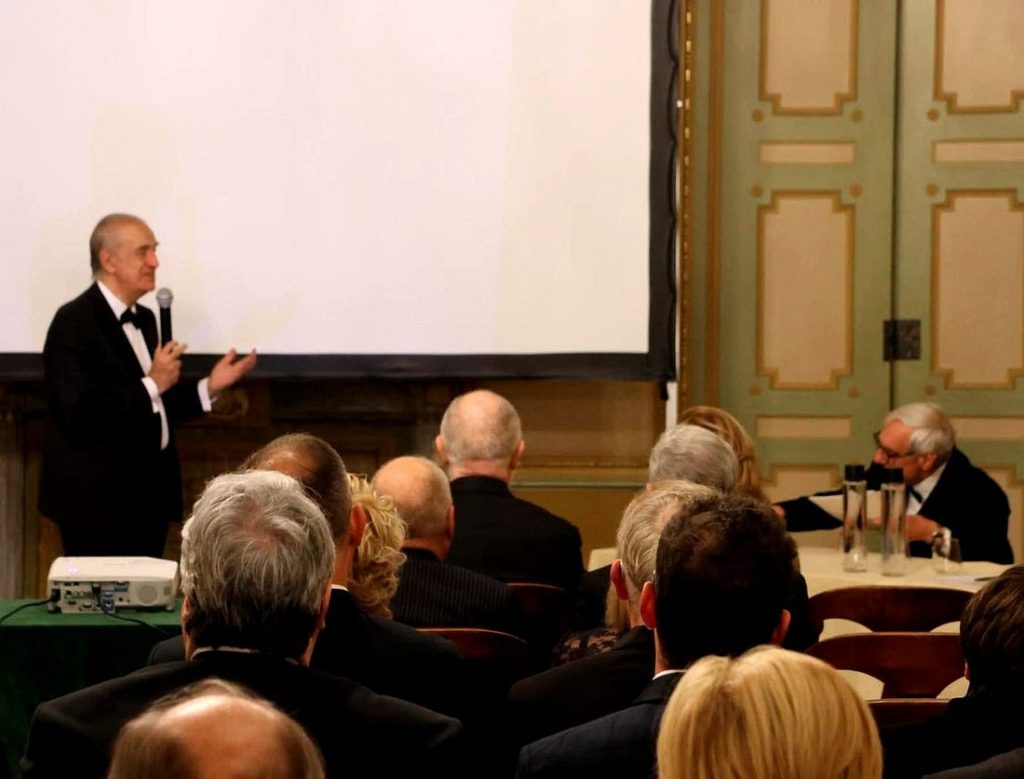
Nob.Dott. Pier Felice degli Uberti, addressing the participants of the Lo Storico Galà della Nobiltà 2025
The assembly adopted a proposal to renew the ICOC’s Scientific Committee, expanding it beyond heraldry and genealogy to specialists in law, institutional history, anthropology, and diplomatics. This interdisciplinary approach aims to create “an updated, documented and universally recognized framework of chivalric realities” suited to today’s context.
At the close of the meeting, participants held a dedicated session on H.R.H. Prince Emanuele Filiberto of Savoy’s Royal Protocol, highlighting its alignment with the ICOC’s objectives. The Scientific Committee of Royal Protocol, national and international, was introduced, indicating close collaboration between the project and ICOC experts to ensure academic rigor and legitimacy.
The assembly also formally launched preparations for the 37th International Congress of Genealogical and Heraldic Sciences, to be hosted in the Republic of San Marino in October 2026, where the revised Principles will be presented and debated. The Commission stated that updating the 1962 Principles will reaffirm the ICOC as “the guardian of historical truth and the moral value of chivalric institutions,” honoring its origins while preparing for the future.
In conclusion, the ICOC signaled its intent to remain the gold standard of chivalric legitimacy. The modernized Principles will reinforce that genuine orders of chivalry embody ethical purpose, cultural heritage, and historical continuity, rather than social prestige alone.
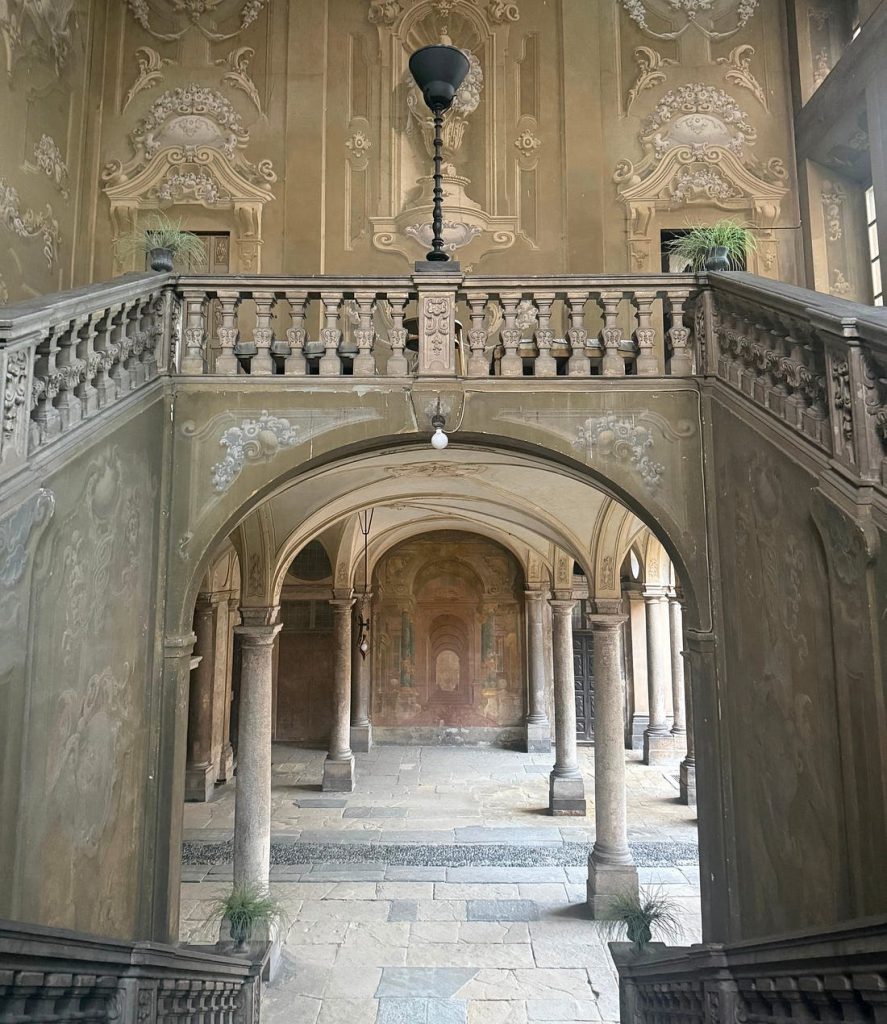
The entry hall and famous staircase of Palazzo Gozzani di Treville in Casale Monferrato
Bridging Past and Future
As the evening closed, Prince Emanuele Filiberto’s words lingered: an appeal to history, nobility, and truth. They captured the spirit of the day, a commitment to carrying Europe’s noble and chivalric heritage forward, as a living legacy shaped by thoughtful stewardship and innovation for the 21st century.
Stepping into the crisp Monferrato night, guests left a scene where past and future stood side by side, and the quiet sense that something historic had unfolded.
Lo Storico Galà della Nobiltà and the ICOC General Assembly had woven a unified narrative, a chivalric and nobility legacy renewed. The glory of the past was not merely preserved; it was set on a path to inspire the decades ahead, ensuring that the enduring values of honor, service, and cultural patronage remain vibrant for generations to come.